
How to Prepare Your Raw Materials for Black Friday
3 min read

Shopify shows how many hoodies are on the shelf, not whether you have the fabric to make more. For brands that make their products, that’s where Black Friday goes wrong.
Count your materials, work out what they let you make, order what’s short while suppliers can still deliver, make your bestsellers early, and check your margins before you discount.
1. Count every material (4 weeks before)
Count what’s on the shelf, not what your records say: fabric, ingredients, components, labels, and packaging. Running out of boxes stops orders just as surely as running out of fabric.
2. Work out what you can make
For each variant, divide each material’s stock by how much one unit uses. The lowest result is how many you can make.
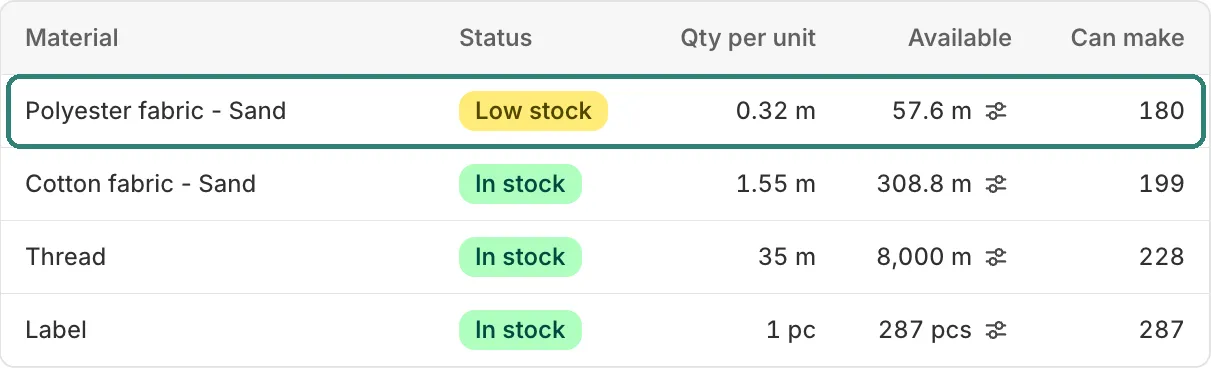
Cotton fabric covers 199 hoodies, but Polyester fabric only covers 180. That’s your real number.
Materials shared between products, like thread, labels, and boxes, are used up by everything you sell at once.
3. Compare with what you’ll sell
Start from last year’s BFCM orders, or your best week this year if it’s your first. Then check what that volume needs.
Say you expect to sell 410 hoodies and have 170 on the shelf. Making 240 more needs 76.8 m of Polyester fabric (you have 57.6 m), 372 m of Cotton fabric (you have 308.8 m), and 8,400 m of thread (you have 8,000 m). At higher volume, three materials fall short, not one.
4. Order what’s short, now
Ask suppliers for their November lead times and last order dates. Order what step 3 says you’re missing, plus a buffer on the materials that limit you most, and don’t forget packaging.
5. Make your bestsellers early (2 weeks before)
Make bestsellers in advance, in batches, so orders ship straight from the shelf. Keep slower sellers and custom options made to order, so their materials stay free for what sells.
Record each batch when it’s done: materials go down and finished products go into Shopify inventory. Skip it, and your material stock looks higher than it is.
6. Check your margins before you discount
A hoodie that costs €26.78 to make and sells for €72:
| Discount | Price | Profit | Margin |
|---|---|---|---|
| None | €72.00 | €45.22 | 62.8% |
| 30% off | €50.40 | €23.62 | 46.9% |
| 50% off | €36.00 | €9.22 | 25.6% |
That’s before payment fees and shipping. If material prices went up this year, update your costs first, or a deep discount can mean selling at a loss.
Run your own numbers with the free Product Cost Calculator, which shows profit and margin at any discount.
7. During the sale
Check material stock daily. Products made in advance can only sell what’s on the shelf, so the risk is in products made to order: Shopify doesn’t know when their materials run out. If a material runs low, lower those products’ inventory in Shopify to what you can still make, or make another batch.
8. After the sale
Count again and note what sold more than expected and what ran out first. Next year’s plan starts from real numbers.
Where Silva: Raw Material Inventory fits
We make Silva: Raw Material Inventory, so this part is about our app.
- Step 2 is done for you: each variant shows how many you can make, and materials show Low stock and Out of stock.
- Step 5 is quick: recording a batch updates material stock and adds the products to Shopify inventory.
- Step 6 stays current: each variant’s cost and margin update when material costs change.
- Step 7 is a glance: turn on Sync Shopify inventory for made-to-order products, and Shopify inventory follows what you can make, so the rush can’t oversell a material you’ve run out of.
It’s free for life for early users, with no limits on materials or orders, so you can set up your whole range before BFCM.